Residential vs Commercial Property: Which Is a Better Investment in India?
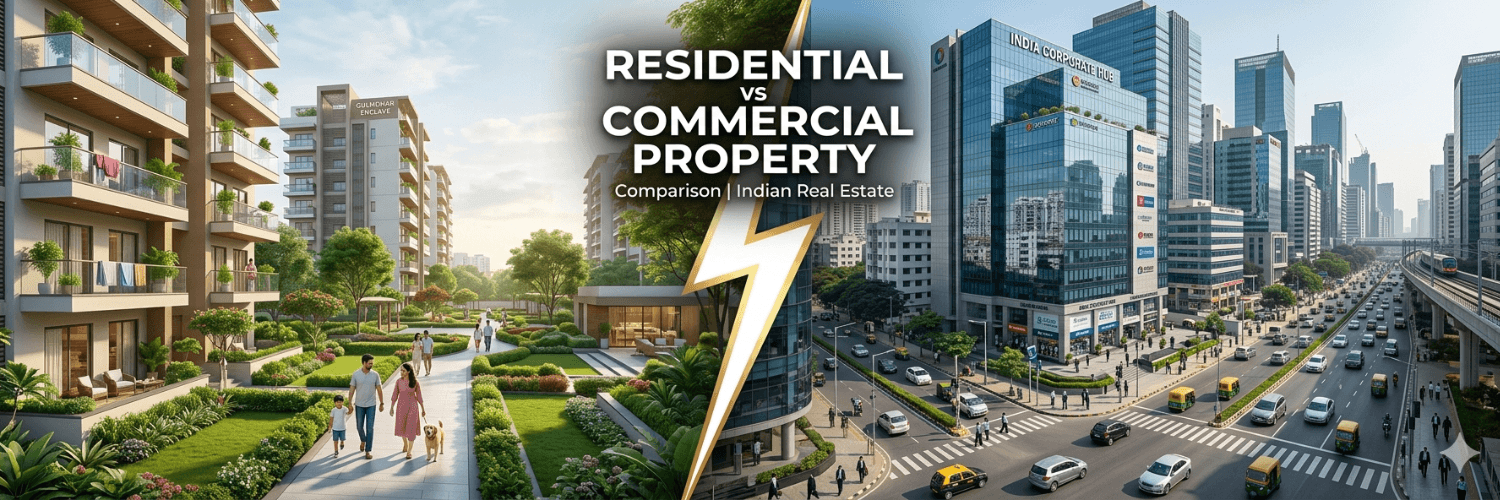

The real estate sector in India is thriving, offering investors a range of opportunities across residential and commercial properties. With cities such as Pune luring professionals, families, and businesses from all over the country, it has become the hub for real estate investment in Pune. The residential vs commercial property investment has been a topic of discussion, and both have their own set of pros and cons. To understand which one suits your investment needs, it is important to examine the factors that affect both segments and the market trends.
In this blog, we will discuss the factors that need to be considered when comparing residential and commercial properties. The choice is simple and depends on your investment needs, risk tolerance, and the overall economic scenario, particularly in the rapidly growing real estate market in Pune.
Understanding the Market: Residential and Commercial Property Investments
Before moving into the advantages of both Residential and Commercial properties, it is important to first understand the present scenario of the real estate market in Pune. According to a latest report, the Residential market in Pune has seen a rise of 12% in property registrations in the first quarter of 2025. There is also a rise in demand for luxury and mid-range properties. In contrast, the demand for commercial properties in Pune is also increasing, given the rise in IT and Industrial hubs. There is an increasing demand for commercial spaces in Pune, and rentals have seen a rise of 8-10%.
Residential vs. Commercial Property Investment - What Are the Key Differences?
1. Capital Appreciation vs. Cash Flow
Residential Property: Traditionally, residential properties have offered long-term capital appreciation. For instance, in the case of Pune, areas like Hinjawadi, Viman Nagar, and Kharadi have witnessed increased demand due to infrastructural development and their proximity to IT hubs. According to recent reports, residential properties in Pune have witnessed an average capital appreciation of 5-7% annually over the past 5 years .
Commercial Property: Commercial properties, on the other hand, offer cash flow in the form of rental income, especially if they are located in key business areas. With the development of commercial areas in Pune, like Hinjawadi IT Park and Kharadi, rental income for office spaces has witnessed a hike of 8-10%.
2. Risk Factors and Stability
Residential Property: Residential properties are relatively less risky due to consistent demand. Yet, market fluctuations in property prices may be observed, especially in areas that are impacted by the economic downturn. In Pune, though, areas with high demand for rental properties and infrastructure development are less risky.
Commercial Property: Commercial properties are relatively riskier but also provide higher returns. The rental income may fluctuate depending on market demand for office space, financial viability of the tenants, and macroeconomic trends. However, with Pune’s thriving IT and manufacturing sectors, commercial properties in established sectors like Hinjawadi, Ravet, and Kharadi are identified as high-risk, low-risk investment opportunities for those seeking long-term rental yields.
3. Liquidity and Exit Strategy
Residential Property: The liquidity of residential properties is relatively slower compared to commercial properties. But residential properties have a wider market, and as such, there is always demand for buying and renting. With the increasing population of Pune, the demand for housing is not likely to slow down anytime soon.
Commercial Property: The liquidity of commercial properties may be a concern. It may take a relatively longer time to sell a commercial property because of the limited number of buyers, especially in a situation where the market is uncertain. But commercial properties with high rental demand, such as those situated near IT parks, have strong exit options in terms of appreciation and yield.
4. Maintenance and Operational Expenses
Residential Property: Maintenance costs are also low for residential properties. Operational activities like maintenance, services, etc., are quite manageable for residential properties. For the owner, residential properties in Pune don't demand much operational attention, except for maintenance and management of tenants.
Commercial Property: Maintenance and operational costs are high for commercial properties. Starting from CAM costs, operational attention is needed for services, etc., for commercial properties. However, this expense also goes to the tenants in the form of rentals.
5. Tax Benefits and Deduction
Residential Property: The tax benefits of residential properties are mainly derived from the deduction of home loan interest and exemption of property taxes. Investors are attracted to these deductions when they purchase properties for personal use or for investment purposes.
Commercial Property: In the case of commercial properties, the major tax benefit is the deduction of property value through depreciation. Moreover, the income generated from the property can also be treated as business income, thus providing more tax relief to the investors who use the property for income generation.
Conclusion
Residential vs commercial property investment has its own pros and cons. For those who are looking for long-term capital appreciation with relatively lower risk, residential properties in Pune are a good option. On the other hand, for those who are looking for higher returns with consistent cash flow, commercial properties are a good option, especially in the rapidly developing areas of Hinjawadi, Kharadi, and Viman Nagar.
The real estate market in Pune has a bright future with steady growth in both residential and commercial sectors. For those who are looking to make informed decisions regarding real estate investment in Pune, the key to success lies in market trends, risk, and investment objectives.
FAQ
It depends on your goal. Residential property is better for stability, lower risk, and easier resale, while commercial property offers higher rental yields and long-term income potential.
Residential properties are typically easier to buy, finance, and manage, with consistent demand from families. Commercial properties require higher investment but provide higher rental returns, longer lease terms, and better income stability.
Commercial properties usually generate higher rental yields (6%–10%), whereas residential properties offer lower returns (2%–4%) but with more stable occupancy and lower vacancy risk.
Yes, commercial property can be riskier due to higher vacancy periods, market fluctuations, and dependency on business performance. However, it also offers higher returns if managed well.
- Residential investment is ideal for first-time buyers, salaried individuals, and low-risk investors.
- Commercial investment suits experienced investors looking for higher returns, rental income, and long-term wealth creation.
Related Blogs

Property Investment in Pune: How to Calculate Rent...

Commercial Property vs Office Spaces in Pune: Whic...

Top Reasons Why Builders in Pimpri Chinchwad Are A...

Upcoming Commercial Projects in PCMC: Why Business...

How Commercial Investment Projects in Pune Generat...

Office Spaces in Pune: What Businesses Should Cons...

A Homebuyer's Checklist Before Purchasing Resident...

How Builders in Pimpri Chinchwad Are Benefiting fr...

Best Commercial Investment Projects in Pune for Lo...

Commercial Property in Pune: Tax Benefits Every Bu...